Certificates vs Portfolio: What Gets Career Changers Hired
Certificates vs portfolio for career changers: when each one matters, what hiring managers evaluate, and how to build proof louder than any credential.
Career changers face a constant push to collect credentials. Every platform promises that one more certificate will open doors. But hiring data tells a different story: in most digital roles, employers evaluate what you can prove, not what you have completed. If you already mapped your skill gaps and built a roadmap, the next question is how to prove what you know. A personalized career roadmap from Traecta helps you identify which proofs to build — portfolio projects, targeted credentials, or both — based on your target role.
This article breaks down the real value of certificates versus portfolios, shows where each one matters, and gives you a framework for choosing the right proof strategy.
What certificates actually prove in 2026Permalink to “What certificates actually prove in 2026”
A certificate confirms that you completed a structured learning path and passed an assessment. That is useful information, but it has limits. A certificate says you were exposed to material. It does not say you can apply it under real conditions.
Research on hiring signals, including a 2020 study on credential value in labor markets, shows that credentials function as screening tools, not as proof of competence. Employers use them to narrow candidate pools, but final hiring decisions depend on demonstrated ability.
A certificate is a ticket to the interview. A portfolio is what gets you the offer.
This does not make certificates useless. It makes them partial. They work best as one signal among several, not as standalone proof.
The certificate trapPermalink to “The certificate trap”
Many career changers fall into a pattern: complete a course, earn a certificate, feel underprepared, enroll in another course. This cycle is common because certificates provide a clear sense of progress. But progress and proof are not the same thing.
Watch for these signs that you are collecting certificates instead of building proof:
- You have three or more certificates in the same skill area but no project output
- Your LinkedIn "Licenses & Certifications" section grows while your portfolio stays empty
- You cannot explain how each certificate connects to a specific job requirement
- You keep choosing courses over building something because courses feel safer
If you identified your skill gaps using the method from our earlier article, you already know which gaps need filling. The question is whether a certificate or a project is the right tool for each one.
What a portfolio demonstrates that a certificate cannotPermalink to “What a portfolio demonstrates that a certificate cannot”
A portfolio is a collection of completed work that shows how you think, solve problems, and communicate results. Unlike a certificate, it provides direct evidence of applied skill.
Three things only a portfolio provesPermalink to “Three things only a portfolio proves”
- End-to-end execution: You can take a problem from question to conclusion, not just answer quiz questions about individual steps
- Decision-making under ambiguity: You can choose approaches, handle messy data, and explain trade-offs — things no multiple-choice test assesses
- Communication of results: You can present findings in a way that non-technical stakeholders understand, which is what most hiring managers actually care about
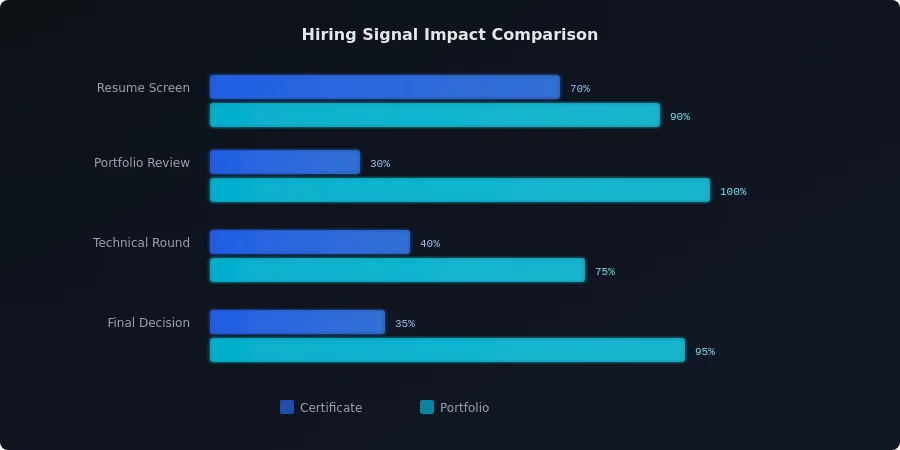
If you built a career transition roadmap based on the milestone method we described, your milestones already produce portfolio artifacts. Each completed milestone is one piece of proof.
Why hiring managers prefer portfolio evidencePermalink to “Why hiring managers prefer portfolio evidence”
Most hiring managers in data, analytics, design, and engineering roles follow a simple evaluation pattern:
- Does the candidate have relevant work?
- Can they explain their process?
- Do their results make sense?
None of these questions require a certificate to answer. They require output. A hiring manager who sees a cleaned dataset, a SQL analysis, or a dashboard with clear insights can evaluate you directly. A certificate only tells them you studied — not whether you can deliver.
When certificates matter (and when they are a distraction)Permalink to “When certificates matter (and when they are a distraction)”
Certificates are not useless. They serve specific functions in specific contexts. The key is knowing when they carry real weight.
Certificates that carry hiring weightPermalink to “Certificates that carry hiring weight”
| Certificate type | When it matters | Why |
|---|---|---|
| Industry-regulated (CPA, PMP, PE) | Always, for regulated roles | Legal or compliance requirement |
| Cloud platform (AWS, GCP, Azure) | When the role is platform-specific | Proves hands-on access and familiarity |
| Data tools (Google Analytics, Tableau) | When listed in multiple postings | Confirms tool proficiency to a standard |
| University-backed programs | For career pivots into new fields | Academic signal for non-traditional candidates |
| Professional body memberships | In finance, law, medicine, engineering | Often legally required |
Certificates that rarely move the needlePermalink to “Certificates that rarely move the needle”
- Generic "Data Science" certificates from course platforms
- Multi-course specializations with no project output
- Certificates for skills you can demonstrate through work
- Certificates from platforms with no proctored assessments
- Any certificate completed but never applied in a project
The market does not reward collecting credentials. It rewards solving problems.
If a certificate does not appear in at least three job postings for your target role, or if you can demonstrate the same skill through a project, skip it.
How to build a portfolio that replaces certificatesPermalink to “How to build a portfolio that replaces certificates”
A strong portfolio does not need to be large. Two to three well-executed projects that match your target role's requirements are enough.
Portfolio project structurePermalink to “Portfolio project structure”
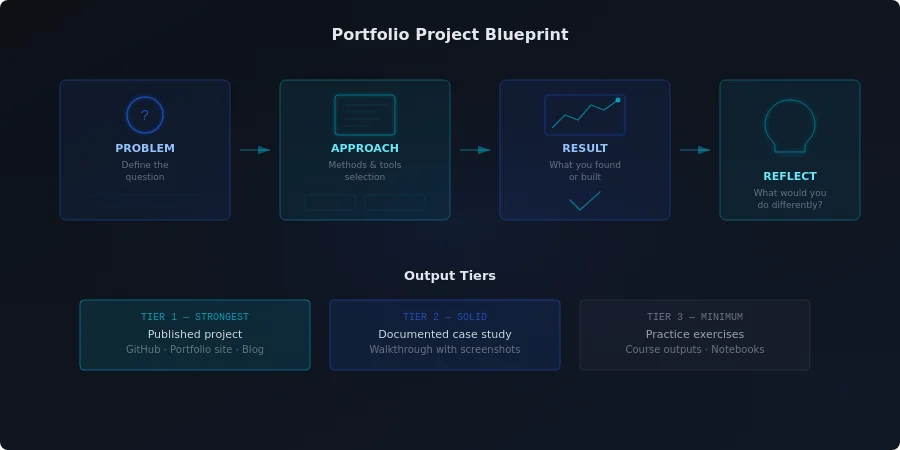
Each project in your portfolio should follow this structure:
- Problem statement: What question or challenge did you address?
- Approach: What methods, tools, and data did you use?
- Result: What did you find, build, or improve?
- Reflection: What would you do differently?
This structure mirrors how hiring managers evaluate work. It also forces you to practice the communication skill that separates candidates who get hired from those who get rejected.
Choosing the right portfolio projectsPermalink to “Choosing the right portfolio projects”
Pick projects that align with your target role's most common requirements. Use this alignment guide:
| Target role | Project type | Example output |
|---|---|---|
| Data Analyst | Exploratory data analysis | Dashboard + written insights |
| Business Analyst | Process improvement case | Workflow diagram + ROI estimate |
| UX Designer | User research project | Persona + wireframe + usability findings |
| Frontend Developer | Feature build | Live site + code repo + technical writeup |
| Project Manager | Initiative planning | Project charter + timeline + risk assessment |
The best projects solve real problems. If you can use data from your current or previous job (anonymized), that is stronger than a synthetic dataset from a tutorial.
Where to host your portfolioPermalink to “Where to host your portfolio”
Keep it accessible. Hiring managers will not download files or request access.
- GitHub for code, data, and documentation
- Personal site or Notion page for project walkthroughs
- LinkedIn featured section for your strongest pieces
- Medium or Substack for written analyses
Traecta helps you organize these proof points into a verified public portfolio that connects directly to your career milestones, so you spend time building instead of formatting.
The hybrid strategy: targeted certification + portfolio proofPermalink to “The hybrid strategy: targeted certification + portfolio proof”
The strongest career change strategy is not certificates versus portfolio. It is the right credential at the right time, backed by applied proof.
When to get the certificate firstPermalink to “When to get the certificate first”
Get a certificate before building projects when:
- The credential is a hard requirement for your target role (regulated fields)
- You need structured learning in a tool you have never used
- The certificate program includes a capstone project you can use as your first portfolio piece
- The credential gives you access to a hiring network or job board
When to build the portfolio firstPermalink to “When to build the portfolio first”
Start with projects when:
- You already have foundational knowledge from prior experience
- Your target role values output over credentials (most data, design, and engineering roles)
- You identified skill gaps that are really proof gaps, not knowledge gaps
- You can demonstrate the skill in a weekend project faster than a six-week course
The fastest career changers do not choose between certificates and portfolio. They choose the right tool for each gap.
A practical decision frameworkPermalink to “A practical decision framework”
For each skill gap on your roadmap, ask:
- Does this skill require a recognized credential? If yes → certificate first
- Can I demonstrate this skill through a project? If yes → portfolio first
- Will a certificate + project together be stronger than either alone? If yes → certificate that produces an output
This framework prevents wasted time. It also ensures that every certificate you earn has an accompanying proof point.
What hiring managers actually evaluatePermalink to “What hiring managers actually evaluate”
To settle the certificates-versus-portfolio question, it helps to understand how hiring decisions are made in practice.
The evaluation funnelPermalink to “The evaluation funnel”
Most hiring processes for digital roles follow this pattern:
- Resume screen: Do you have relevant keywords and experience? (Certificates help here)
- Portfolio review: Does your work demonstrate the required skills? (Portfolio is critical here)
- Technical assessment: Can you perform under realistic conditions? (Neither certificates nor portfolio fully predict this)
- Behavioral interview: Can you communicate and collaborate? (Portfolio walkthroughs prepare you for this)
Certificates serve as a pass-through filter at step 1. But steps 2 through 4 — where actual decisions happen — depend on applied proof.
What to optimize forPermalink to “What to optimize for”
If you have limited time, optimize for the evaluation stage that eliminates the most candidates. In most digital hiring processes, that is step 2: the portfolio review. Candidates without visible proof get filtered out before the technical round, regardless of how many certificates they hold.
ConclusionPermalink to “Conclusion”
Certificates and portfolios serve different purposes. Certificates signal that you studied. Portfolios prove that you can deliver. For most career changers entering data, analytics, design, or engineering roles, building two to three strong portfolio projects will carry more hiring weight than any collection of course completions. Get certificates only when your target role demands them, and always pair them with applied proof. For a detailed guide on how to structure those projects, see our follow-up article on building a project-based portfolio. For why a certificate stopped proving much at all in 2026, from the NYC AI ban to the MIT committee findings, see certificates don't prove skills: what to show instead. If you want a structured path that builds portfolio-ready milestones from your existing skills, start with Traecta — Your Personalized Career Roadmap. It maps your gaps, sequences your learning, and ensures every step produces something you can show an employer.